
Dispatch / CAD API
Your CAD sends a call straight to a unit’s phone. One tap starts the route. Status flows back automatically.
LiveRoutes that skip rush-hour turn bans. The exact house, on the right side of the street. A live map of every unit for your dispatchers.
Average time from a 911 call to arrival at life-threatening medical emergencies in NYC (FY2026). Up 3 min 50 s since FY2015.
NYC Comptroller, Oct 16, 2026Of real response time is spent between pulling up and reaching the patient. A median of 2.1 minutes.
Silverman et al., Acad Emerg Med 2007 (449 NYC calls)Lower odds of good neurological survival from cardiac arrest for every extra minute of EMS response.
Goto et al., J Am Heart Assoc 2018 (553,426 patients)Where the seconds go: the wrong side of the street and a loop around the block. A no-left-turn sign a civilian app obeys. A long one-way, stuck behind a double-parked truck. A new EMT who has never driven the neighborhood.
ResponseOne routes it like a medic who knows the streets.
The crew picks Responder or Regular for each trip. Responder mode applies rules learned on real calls before the rig moves.
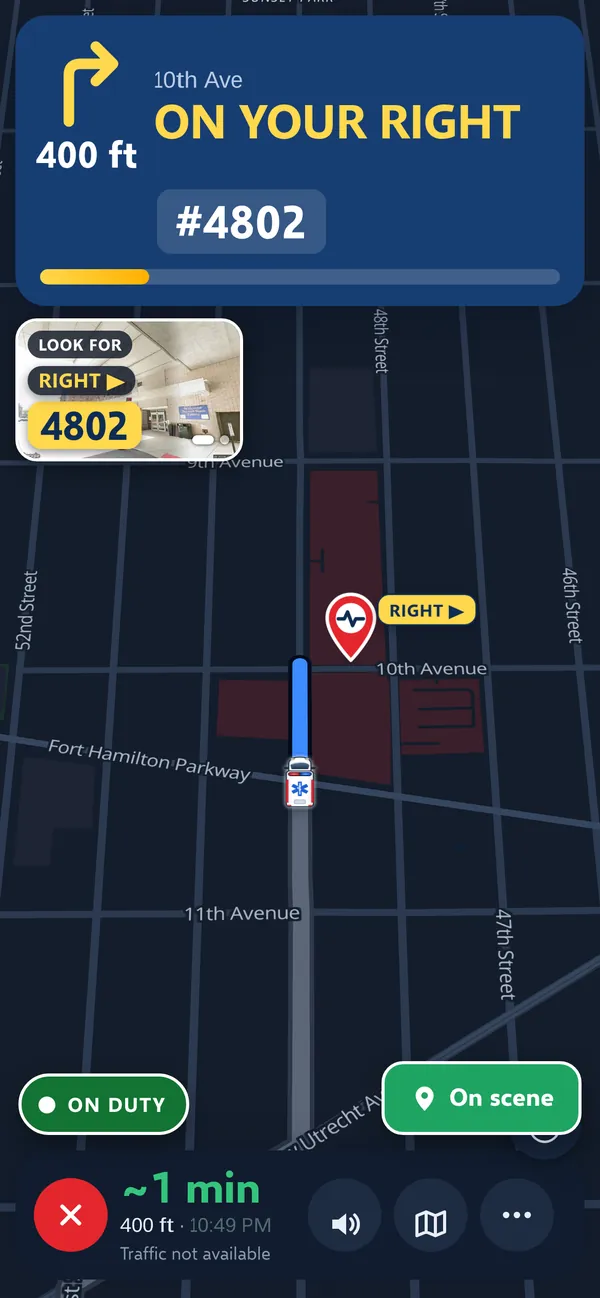
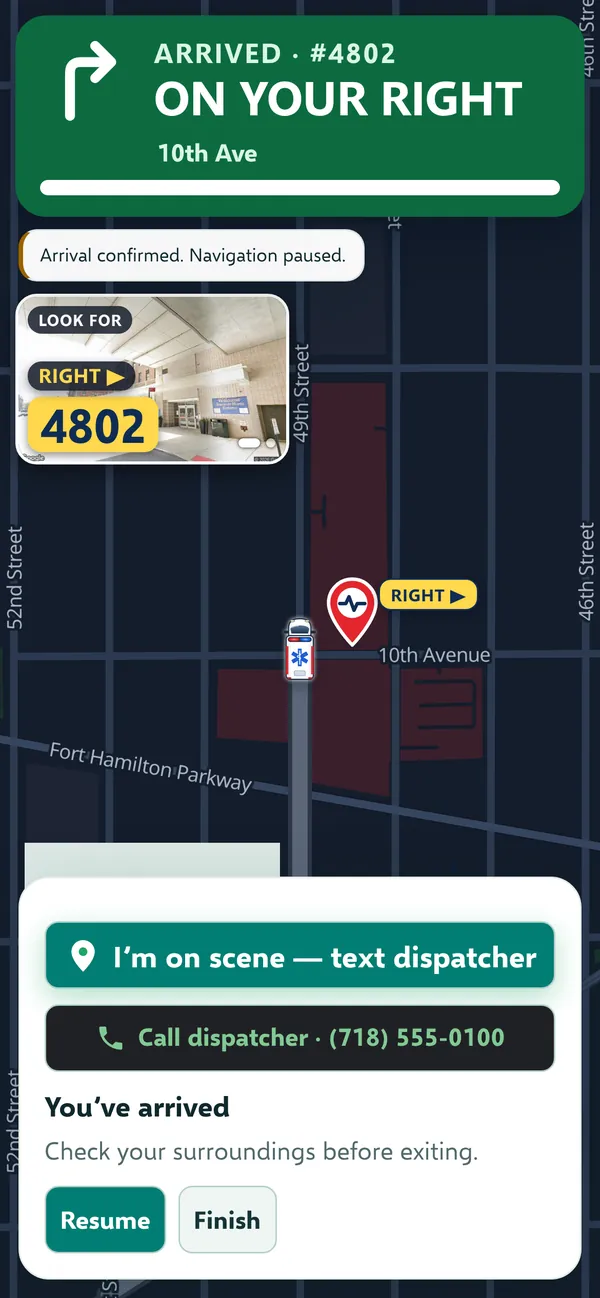
On the final block, ResponseOne switches to arrival mode. The crew knows where to stop before they get there.
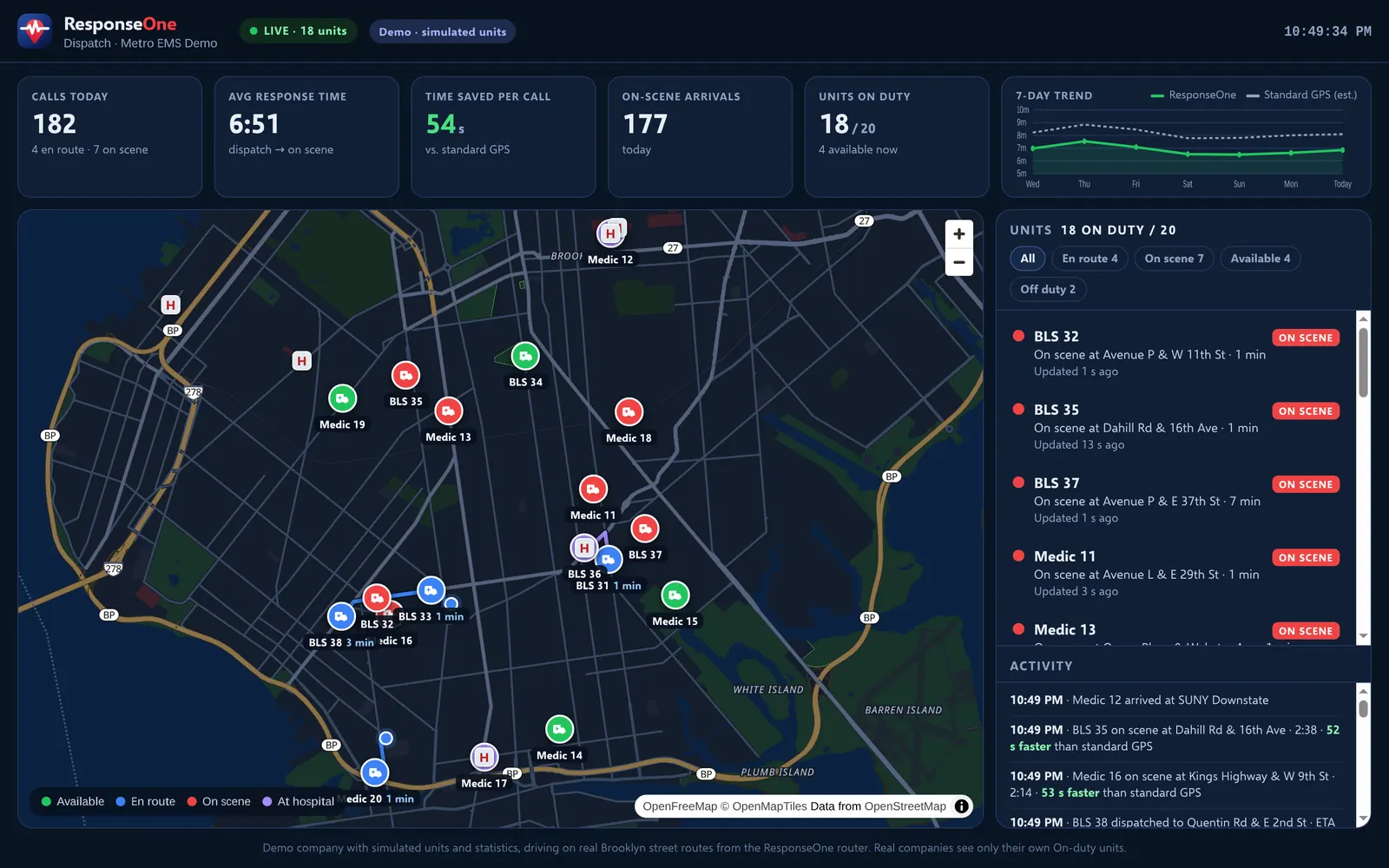
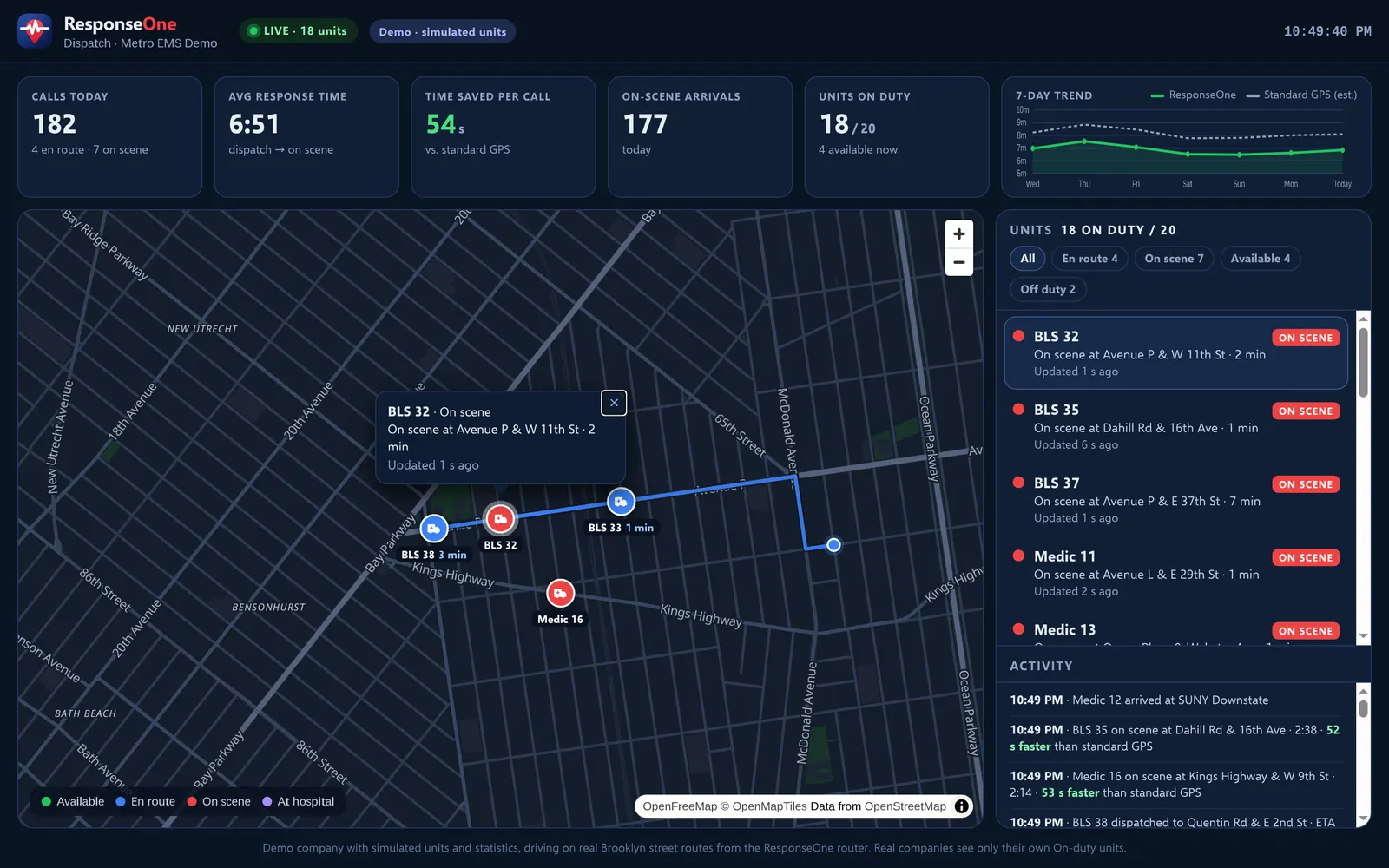
Each company gets its own dispatch view. Status, ETA and last update for every on-duty unit, refreshed every 5 seconds.
A documented REST API for any dispatch system with an open API. The call pops up on the unit’s phone. One tap starts the route.
POST /v1/assignments
Authorization: Bearer r1k_••••••••
Idempotency-Key: CAD-2026-114233

{
  "unitId": "medic-12",
  "externalId": "CAD-2026-114233",
  "address": "4802 10th Ave, Brooklyn, NY",
  "priority": "emergency",
  "notes": "Main entrance"
}
Your CAD sends a call straight to a unit’s phone. One tap starts the route. Status flows back automatically.
LiveOne crew blocks a street. Every unit in the company routes around it within a minute. Blocks expire after 4 hours.
LiveRanked by drive time from the unit. Filter by trauma, thrombectomy stroke, cardiac, burn, pediatric, L&D or psych.
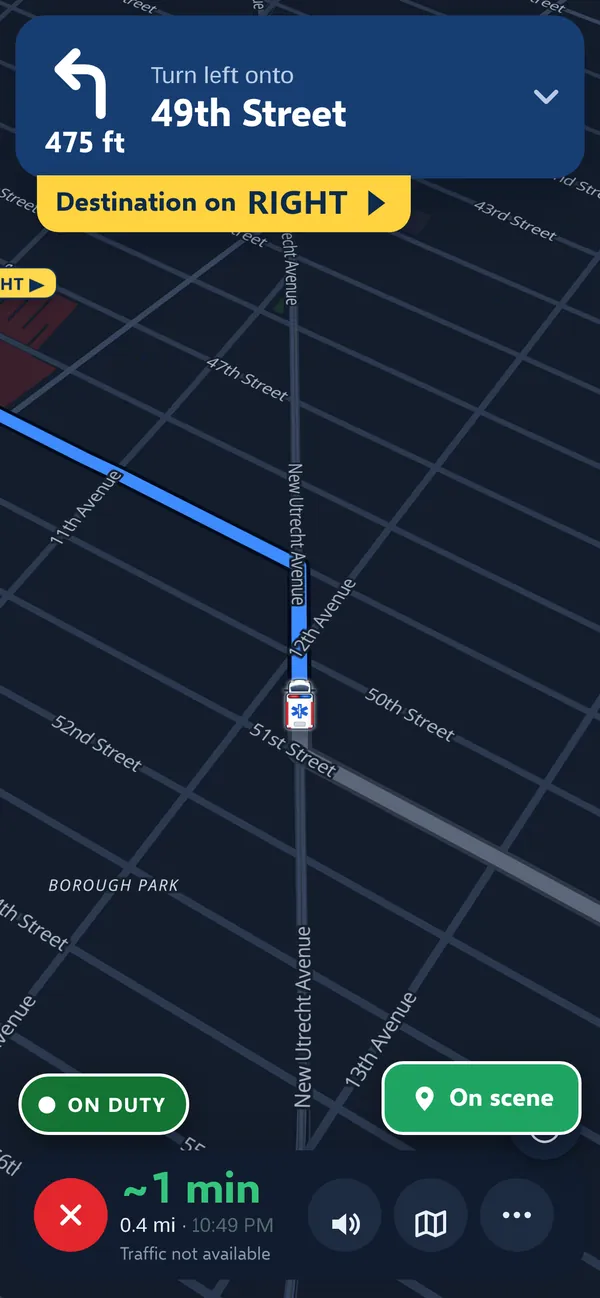
Spoken turn-by-turn with intersection callouts. Tap the banner for the next steps.
Tap an address in a text or WhatsApp. ResponseOne opens straight into the route.
One license per ambulance. Codes lock to one phone. Suspend a company and it’s locked out within a minute.
No signal? The active route and map stay on the phone. The crew sees “Offline — using saved route” and keeps driving.
LiveSwitch to the phone or the patient app. A mini map keeps the route going, with voice.
Routing covers the whole metro area. Side-of-street checks use NYC address data, so they’re sharpest in the five boroughs.
LiveYour company, unit codes and dispatcher login. Your admin manages codes from then on.
Android, iPhone or web. Each code locks to the phone in the rig. Go on duty and drive.
Every on-duty unit on one map. Calls from your CAD go straight to the unit.
60 seconds saved on 60% of calls, and half of the freed time filled with paid trips. An estimate based on these assumptions; a 30-day evaluation measures it for your fleet.
| Scenario | Conservative | Base | Aggressive |
|---|---|---|---|
| Seconds saved / call | 30 | 60 | 90 |
| Annual value | $190k | $819k | $2.08M |
| Value ÷ license cost | 2.7× | 11.7× | 29.6× |
| Payback incl. setup | 4.8 mo | 1.1 mo | 0.4 mo |
All figures are estimates from our ROI model, not results. Inputs: 150 ambulances, 6 responses a day, $1,147 collected per transport (CMS GADCS / RAND, via PWW Advisory Group 2025), 0.40 trips per unit-hour (Fitch 2015), $39 per ambulance per month plus $5,000 setup. The full model is available on request.
Billed yearly. One license = one rig’s phone, whoever is on shift.
30 days · 10 ambulances · one base.
No. It works next to it. Your CAD can send calls straight to a unit through the Dispatch API, and unit status goes back to your CAD.
No. Responder mode only skips congestion turn bans, like “no left turn 7–10 AM”. It never routes the wrong way down a one-way. It gives guidance; crews follow their agency’s emergency vehicle policy and the law.
No. A unit shares its position only while it is on duty, and only with its own company.
Android, iPhone and any modern browser. No extra hardware.
New York City, Long Island, Westchester and New Jersey. It was built and tuned on Brooklyn calls. Side-of-street checks use NYC address data, so they’re sharpest in the five boroughs. Elsewhere? Ask us.
Per ambulance, per month, billed yearly: $49 for 25–49 ambulances, $44 for 50–99, $39 for 100–249, $34 for 250+. Dispatchers and admins are free.
Nothing. 30 days, 10 ambulances, one base. We agree on the success measures before it starts.
Setup takes a day. Crews install and sign in within minutes.
20 minutes on a call. We show you the crew app and your dispatch map, then set up a pilot.